
Acids, bases, and salts are common chemical compounds found in our surroundings. They occur naturally and can also be made artificially. For example, vinegar contains acetic acid, and citrus fruits contain citric acid. They are widely used in industries, laboratories, and manufacturing. When acids react with bases, they form salt and water in a neutralization reaction.
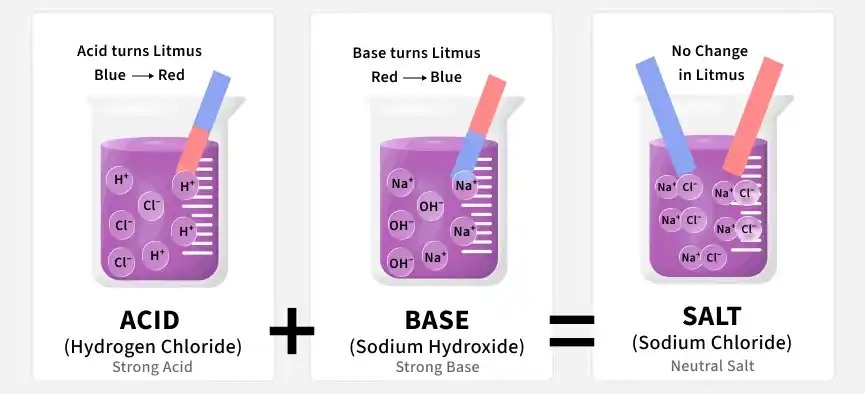
Acid
Acids are chemical substances that produce hydrogen ions (H⁺) when dissolved in water. They are commonly found in nature, such as in citrus fruits and vinegar, and they are widely used in industries and laboratories.
General Properties of Acids
- Acids have a sour taste.
- They turn blue litmus red.
- They have a pH less than 7.
- Aqueous solutions of acids conduct electricity.
- Acids are often corrosive in nature.
- Acids react with bases to form salt and water (neutralization).
Physical Properties of Acids
- Sour in taste (e.g., lemon juice, vinegar).
- Change indicator's color.
- Corrosive to metals and living tissues.
- Low pH value.
- Good conductors of electricity in aqueous solutions.
Chemical Properties of Acids
1. Reaction with Metals
Acids react with metals to produce hydrogen gas and a salt.
Metal + Acid→Salt + Hydrogen
Example: Zn (s) + 2HCl (aq) →ZnCl2 (s) + H2 (g)
2. Reaction with Metal Carbonates
Produces salt, water, and carbon dioxide.
Metal carbonate + Acid → Salt + H₂O + CO₂
Example: Na2CO3 (aq) + 2HCl (aq) → 2NaCl (s) + H2O(l) + CO2(g)
3. Reaction with Metal Hydrogen Carbonates
Produces salt, water, and carbon dioxide.
Acid + NaHCO₃ → Salt + H₂O + CO₂
Example: 2NaHCO3 (aq) + H2SO4 (aq) → Na2SO4 (aq) + 2H2O (l) + 2CO2 (g)
Types of Acids
1. Based on Occurrence
a) Natural (Organic) Acids
- Derived from natural sources.
- Examples: Acetic acid (CH₃COOH), Citric acid, Oxalic acid.
b) Mineral (Inorganic) Acids
- Derived from minerals or synthesized.
- Examples: HCl, H₂SO₄, HNO₃, H₃PO₄.
2. Based on Strength
a) Strong Acids
- Completely ionize in water and produces (H+)
- Examples: HCl, H₂SO₄, HNO₃
b) Weak Acids
- Partially ionizes in water and produces a tiny amount of hydrogen ions (H+).
- Examples: CH₃COOH, H₂CO₃
Uses of Acids
- Acetic acid (vinegar) used as food preservative
- Citric acid used in food and beverages
- Sulfuric acid used in car batteries
- Nitric and sulfuric acids used in fertilizers, dyes, explosives, and paints
- Phosphoric acid used in soft drinks
Bases
Bases are chemical substances that produce hydroxide ions (OH-) when dissolved in water and neutralize acids to form salt and water. Common examples include sodium hydroxide (NaOH), potassium hydroxide (KOH), and calcium hydroxide [Ca(OH)₂].
General Properties of Bases
- Bases have a bitter taste
- They turn red litmus blue
- They have a pH greater than 7
- Aqueous solutions of bases conduct electricity
- Bases feel soapy or slippery to touch
- Bases react with acids to form salt and water (neutralization)
Physical Properties of Bases
- Bitter in taste
- Soapy or slippery to touch
- Change indicator colours (red litmus turns blue)
- pH value greater than 7
- Good conductors of electricity in aqueous solutions
Chemical Properties of Bases
1. Reaction with Metals
Bases react with certain metals to form salt and hydrogen gas.
Alkali + Metal → Salt + Hydrogen
Example: 2NaOH (aq) + 2Al (s) + 2H2O(l) → 2NaAlO2 (s) + 3H2 (g)
2. Reaction with Non-Metallic Oxides
Bases react with acidic oxides to form salt and water.
Non-Metallic Oxide + Base→Salt + H₂O
Example: Ca(OH)2 (aq) + CO2 (aq) → CaCO3 (s) + H2O(l)
3. Reaction with Ammonium Salts
Alkalis react with ammonium salts to release ammonia gas.
Alkali + Ammonium salt → Salt + Water + Ammonia
Example: 2NaOH (aq) + (NH4)2SO4(aq)→Na2SO4(aq) + 2H2O(l) + 2NH3(g)
Types of Bases
1. Based on Acidity (Number of OH⁻ Ions)
- Monoacidic: Bases with one hydroxyl ion (OH⁻). Eg:- NaOH, KOH
- Diacidic: Bases with two hydroxyl ions (OH⁻). Eg:- Ca(OH)₂, Mg(OH)₂
- Triacidic: Bases with three hydroxyl ions (OH⁻). Eg:- Al(OH)₃
2. Based on Concentration
- Concentrated bases: High base content in their aqueous solution.
- Dilute bases: Low base content in there aqueous solution.
3. Based on Degree of Ionization
- Strong bases: Completely ionize in water. Eg:- NaOH, KOH
- Weak bases: Those bases that Partially ionize in water. Eg:- NH₄OH.
Uses of Bases
- NaOH: Soap, paper, and rayon manufacturing.
- Ca(OH)₂: Bleaching powder, whitewashing, soil treatment.
- Mg(OH)₂: Antacid and laxative (milk of magnesia).
- NH₄OH: Laboratory reagent.
Alkali
Alkalis are bases that are soluble in water.
Example: NaOH, KOH
Difference Between Alkali and Base
| Alkali | Base |
|---|---|
| Water-soluble bases | May or may not be water-soluble |
| All alkalis are bases | Not all bases are alkalis |
| Alkalis release OH⁻ ions in aqueous solutions. | Bases neutralize acids to form salt and water. |
| Example: NaOH, KOH | Example: CuO, Zn(OH)₂ |
Theories of Acids and Bases
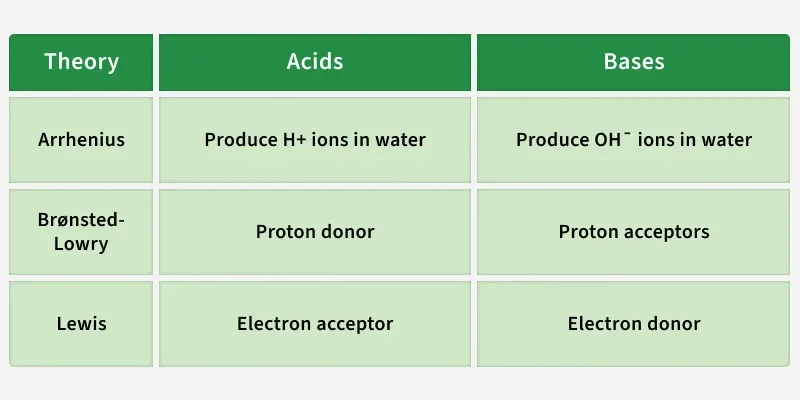
Over the years, chemists have proposed several theories to explain the nature and behaviour of acids and bases. Each theory builds upon and broadens the limitations of the previous one, providing a more comprehensive understanding of acid-base chemistry.
- Arrhenius Theory
- Brønsted–Lowry Theory
- Lewis Theory
1. Arrhenius Concept of Acids and Bases
According to Arrhenius:
- Acids are substances that produce H⁺ ions when dissolved in water.
- Bases are substances that produce OH⁻ ions when dissolved in water.
Examples:
- HCl (aq) → H+ + Cl-
- NaOH (aq) → Na+ + OH-
Limitation:
This theory is applicable only to aqueous solutions and cannot explain the basic nature of substances like ammonia.
2. Brønsted–Lowry Theory of Acids and Bases
According to Brønsted– Lowry:
- Acids are proton (H⁺) donors
- Bases are proton (H⁺) acceptors
In this theory, acids and bases exist as conjugate acid–base pairs.
- Acid ⇌ Proton + Conjugate Base
- Base + Proton ⇌ Conjugate Acid
Examples:
- H2SO4→ H+ + HSO4-
- OH- + H+→ H2O
Advantages:
- Applicable to non-aqueous reactions
- Explains amphoteric substances like water
3. Lewis's Concept of Acids and Bases
According to Lewis:
- Lewis acids are substances that accept an electron pair
- Lewis bases are substances that donate an electron pair
Examples:
- Lewis acids: ( Cu2+, Fe3+, BF3 )
- Lewis bases: ( NH3, Cl -)
Significance:
This is the most general theory, explaining acid–base reactions even without proton transfer.
Strength of Acids and Bases
The strength of an acid or base depends on the concentration of hydrogen ions (H⁺) or hydroxide ions (OH⁻) present in its aqueous solution.
- Strong acids produce a high concentration of H⁺ ions in water, while weak acids produce fewer H⁺ ions.
Example: Strong acid – H₂SO₄, Weak acid – CH₃COOH - Strong bases produce a high concentration of OH⁻ ions in water, whereas weak bases produce fewer OH⁻ ions.
Example: Strong base – KOH, Weak base – Ca(OH)₂
The strength of acids and bases is commonly measured using the pH scale.
pH Scale
The pH scale measures the acidity or basicity of a solution and is defined as
- Acids: pH < 7
- Bases: pH > 7
- Neutral solutions: pH = 7
A lower pH indicates a stronger acid, while a higher pH indicates a stronger base.

Read : Importance of pH in Everyday Life , pH Calculation.
Indicators
Indicators are chemical substances used to identify whether a solution is acidic, basic, or neutral. They show different colors in acidic and basic solutions due to changes in pH. Indicators may be obtained from natural sources or prepared artificially in laboratories.
- pH range 0–7: Acidic solution
- pH = 7: Neutral solution
- pH range 7–14: Basic solution
A common example is the litmus test, which helps distinguish acids and bases.
Types of Indicators
1. Natural Indicators
These are obtained from plants or living sources.
Examples: Litmus, red cabbage juice, turmeric
2. Synthetic Indicators
These are chemically prepared in laboratories.
Examples: Phenolphthalein, methyl orange
3. Olfactory Indicators
These indicators show a change in smell in acidic or basic solutions.
Examples: Onion, vanilla, clove oil

Salts
Salts are ionic compounds formed when an acid reacts with a base in a neutralization reaction. During this reaction, hydrogen ions (H⁺) from the acid combine with hydroxide ions (OH⁻) from the base to form water, and the remaining ions form a salt.
Example: Sodium chloride (NaCl), commonly known as table salt.
Salts are electrically neutral overall but consist of positively charged cations and negatively charged anions held together by electrostatic attraction.
Physical Properties of Salts
- Mostly crystalline in nature
- Can be colourless or coloured, transparent or opaque
- Generally soluble in water
- Conduct electricity in molten state or aqueous solution
- May have salty, sour, sweet, bitter, or umami taste
- Neutral salts are usually odorless.
Also Check: Neutralization Reaction
Types of Salts
1. Acidic Salts
- Formed by the reaction of a strong acid and a weak base.
- They produce an acidic solution in water.
- Examples: Ammonium chloride (NH₄Cl), ammonium sulfate ((NH₄)₂SO₄)
Explanation:
a. Ammonium chloride is formed when hydrochloric acid (a strong acid) interacts with ammonium hydroxide (a weak base).
NH4OH + HCl → NH4Cl + H2O
b. Ammonium sulphate is formed when ammonium hydroxide (a weak base) reacts with sulphuric acid (a strong acid).
2NH4OH + H2SO4 → (NH4)2SO4 + 2H2O
2. Basic (Alkaline) Salts
- Formed by the reaction of a strong base and a weak acid.
- They produce a basic solution in water.
- Examples: Sodium carbonate (Na₂CO₃),sodium acetate (CH₃COONa)
Explanation:
Sodium carbonate is formed when sodium hydroxide (a strong base) reacts with carbonic acid (a weak acid)
H2CO3 + 2NaOH → Na2CO3 + 2H2O
Sodium acetate is formed when a strongly basic, sodium hydroxide (a strong base), reacts with acetic acid (a weak acid)
CH3COOH + NaOH → CH3COONa + H2O
3. Neutral Salts
- Formed by the reaction of a strong acid and a strong base.
- Their aqueous solutions have pH = 7.
- Examples: Sodium chloride (NaCl), Sodium sulphate (Na₂SO₄)
Explanation:
Sodium Chloride is formed when hydrochloric acid (a strong acid) mixes with sodium hydroxide (a strong base).
NaOH + HCl → NaCl + H2O
Sodium sulphate is formed when sulphuric acid (a strong acid) mixes with sodium hydroxide (a strong base).
2NaOH + H2SO4 → Na2SO4 + 2H2O
4. Double Salts
- Contain more than one cation or anion and crystallize together.
- Example: Rochelle salt (KNaC₄H₄O₆·4H₂O)
5. Mixed Salts
- Contains common cations or anions from different salts.
- Example: Bleaching powder (CaOCl 2)
Cause of Formation of Different Salts
- Strong acid + Weak base → Acidic salt
- Strong base + Weak acid → Basic salt
- Strong acid + Strong base → Neutral salt
Also Check: Family of Salts
Some Common Salts
Salts are formed by the neutralization reaction between acids and bases. While sodium chloride (common salt) is the most familiar, many other salts are widely used in daily life and industries.
1. Baking Soda (Sodium Hydrogen Carbonate)
- Chemical Name: Sodium hydrogen carbonate
- Formula: NaHCO
- Nature: Mild basic salt, white crystalline powder
Preparation
Uses
- Used as an antacid to relieve acidity.
- Used in baking to make cakes and bread soft and fluffy.
- Used in soda-acid fire extinguishers.
- Used as a water softener.
2. Washing Soda (Sodium Carbonate)
- Chemical Name: Sodium carbonate
- Formula: Na₂CO₃.10H₂O
- Nature: Strong basic salt
Preparation
Uses
- Used in glass, soap, and paper industries
- Used as a cleaning agent
- Used to remove permanent hardness of water
- Used in the manufacture of other sodium compounds
3. Bleaching Powder (Calcium Hypochlorite)
- Chemical Name: Calcium hypochlorite
- Formula: CaOCl₂
Preparation
Uses
- Used for bleaching cotton, linen, and wood pulp
- Used as a disinfectant for drinking water
- Used as an oxidising agent in industries
Water of Crystallisation
Some salts form crystals that contain a fixed number of water molecules called water of crystallization. Heating these salts removes water, changing their color and properties.
Example:
- Copper sulphate: CuSO₄. 5H₂O
- Washing soda: Na₂CO₃ . 10H₂O
1. Plaster of Paris (POP)
- Chemical Name: Calcium sulphate hemihydrate.
- Formula: (
\mathrm{CaSO_4 \cdot \tfrac{1}{2}H_2O} ) - On adding water, Plaster of Paris sets back into gypsum, forming a hard mass.
Preparation
Uses
- Used for casting toys, statues, and decorative items.
- Used in plaster casts for fractured bones.
- Used for smooth finishing of walls.