
Chemical bonding is the process by which atoms, ions, or molecules combine to form stable chemical compounds. The attractive force holding these particles together is called a chemical bond.
- When atoms approach each other, both attractive and repulsive forces act between them.
- Bond formation occurs when attractive forces dominate, lowering the system’s energy and increasing stability.
- Stronger bonds generally produce more stable compounds.
Most elements do not exist freely in nature. They combine to form molecules or ionic compounds.
- To explain why atoms bond and why molecules have fixed shapes, scientists proposed different bonding theories.
Theories of Chemical Bonding
1. Lewis Theory of Chemical Bonding
Lewis explained bonding based on valence electrons.
- An atom consists of a positively charged nucleus (kernel) and outer valence electrons.
- The outermost shell can hold a maximum of 8 electrons (octet rule).
- Atoms become stable when they achieve an octet configuration.
- Only valence electrons participate in bond formation.
Atoms achieve stability by:
- Transfer of electrons → Ionic bond (e.g., NaCl)
- Sharing of electrons → Covalent bond (e.g., H₂, Cl₂, F ₂)
Lewis Symbols:
- Valence electrons are represented by dots around the element symbol.
- Number of dots = Number of valence electrons.
- Valency = Number of electrons lost, gained, or shared (usually equal to the number of dots or 8 minus the number of dots).
2. Kössel’s Theory of Chemical Bonding
Kössel focused on ionic bonding.
- Alkali metals are electropositive; they lose electrons.
- Halogens are electronegative; they gain electrons.
- Electron transfer forms positive and negative ions.
- Ions achieve noble gas configuration (ns²np⁶).
- Oppositely charged ions attract each other, forming an ionic (electrovalent) bond.
Eg: Formation of NaCl
Na → Na⁺ + e⁻
Cl + e⁻ → Cl⁻
Na⁺ + Cl⁻ → NaCl
Octet Rule

The octet rule states that atoms combine by losing, gaining, or sharing electrons so that they achieve eight electrons (8e-) in their outermost shell, similar to noble gases. This rule forms the basis of most bonding theories.
There are a few exceptions to this rule:
- Incomplete octet → BF₃
- Expanded octet → PCl₅, SF ₆
- Odd electron species → NO
Types of Chemical Bonds
A chemical bond is the attractive force that holds atoms, ions, or molecules together in a chemical species. Through chemical bonding, atoms achieve a stable electronic configuration, usually an octet configuration. The four major types of chemical bonds are explained briefly below.
1. Ionic Bond
An ionic bond happens when one atom completely gives away its valence electrons to another atom, creating positively charged cations and negatively charged anions. The bond happens because positively and negatively charged ions attract each other strongly, and it usually forms between atoms that have very different abilities to attract electrons.
Eg: NaCl
Ionic compounds usually have high melting and boiling points, are soluble in water, and conduct electricity in molten or aqueous states.
2. Covalent Bond
A covalent bond is formed when atoms share one or more pairs of electrons in order to attain stability. These bonds occur between atoms with small electronegativity differences and are directional in nature.
- Single bond → one shared pair (H ₂)
- Double bond → two shared pairs (O₂, CO₂)
- Triple bond → three shared pairs (N₂)
Covalent compounds generally have low melting and boiling points, poor electrical conductivity, and are often insoluble in water.
3. Hydrogen Bond
A hydrogen bond is a weak attractive force between a hydrogen atom bonded to a highly electronegative atom (F, O, or N) and another electronegative atom of the same or a different molecule.
It is of two types:
- Intermolecular hydrogen bond (between molecules)
- Intramolecular hydrogen bond (within a molecule)
Hydrogen bonding significantly affects the physical properties of substances.
4. Metallic Bond
A metallic bond involves the collective sharing of delocalized valence electrons among positively charged metal ions. This “sea of electrons” explains the conductivity, malleability, ductility, and luster of metals.
The strength of metallic bonding depends on the number of delocalized electrons, the charge on metal ions, and the ionic radius.
Lewis Representation of Simple Molecules (Lewis Structures)
Lewis dot structures represent molecules and ions by showing:
- Shared electron pairs (bonds)
- Lone pairs of electrons
- Fulfilment of the octet rule
Although Lewis structures do not show the actual shape of molecules, they help in understanding bonding, valency, and electron distribution.
Steps to Write Lewis Structures
- Count total valence electrons of all atoms.
- Example: CH₄ → 4 (C) + 4×1 (H) = 8 electrons
- Adjust electrons for ions:
- Add one electron for each negative charge
- Subtract one electron for each positive charge
- Choose the central atom:
- Usually the least electronegative atom
- Example: C in CO₃²⁻, N in NF₃
- Form single bonds first using shared pairs.
- Distribute remaining electrons as:
- Lone pairs, or
- Multiple bonds (double/triple)
- Ensure each atom satisfies the octet rule (or duet for H).

Lattice Enthalpy
Lattice enthalpy is defined as the energy required to separate one mole of an ionic solid into its gaseous ions.
Example:
Lattice enthalpy of NaCl = 788 kJ mol⁻¹
Although the sum of ionization enthalpy and electron gain enthalpy may be positive, the large energy released during lattice formation makes the compound stable. Thus, lattice enthalpy is a better measure of ionic compound stability than octet formation alone.

Bond Parameters
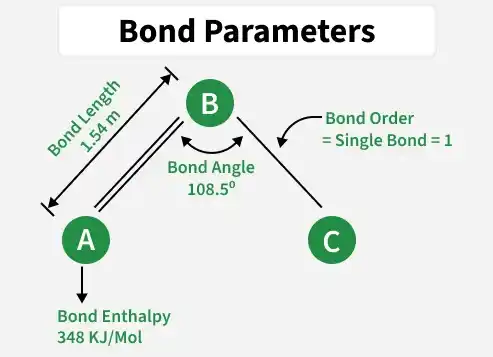
1. Bond Length
Bond length is the equilibrium distance between the nuclei of two bonded atoms. In covalent bonds, bond length equals the sum of the covalent radii of the bonded atoms.
Shorter bond length indicates stronger bonding
Bond length (R) = rA + r B.
2. Bond Angle
A bond angle is the angle between two bonds around a central atom. It gives information about the shape of a molecule.
Example: H–O–H bond angle in water ≈ 104.5°
3. Bond Enthalpy
Bond enthalpy is the energy required to break one mole of a bond in the gaseous state. And for polyatomic molecules, the average bond enthalpy is used because bond strength varies with the molecular environment.
Higher bond enthalpy → stronger bond
Examples:
- H–H = 435.8 kJ mol⁻¹
- O=O = 498 kJ mol⁻¹
- N≡N = 946 kJ mol⁻¹
4. Bond Order (B.O.)
Bond order is the number of bonds between two atoms.
Higher bond order → higher bond enthalpy and shorter bond length
- H–H → Single Bond → B.O = 1
- O=O → Double Bond → B.O = 2
- N≡N → Triple Bond B.O =3
Isoelectronic species have the same bond order (e.g., N₂, CO, NO⁺ → bond order 3).
Resonance and Resonating Structure
Sometimes a single Lewis structure cannot explain experimental observations. In such cases, resonance is used. Resonance structures are sets of Lewis structures that describe the delocalization of electrons in a polyatomic ion or a molecule.
Example: Ozone (O ₃)
Both O–O bonds are experimentally equal, but Lewis structures show one single and one double bond. The actual structure is a resonance hybrid of multiple canonical forms.
Important points about resonance:
- Canonical structures do not exist independently
- The molecule does not oscillate between structures
- Resonance increases stability and averages bond properties.
Polarity of Bonds and Dipole Moment
When a covalent bond is formed between two identical atoms such as H₂ or Cl₂, the shared electron pair lies exactly between the two nuclei due to equal electronegativity. Such a bond is called a nonpolar covalent bond.
In heteronuclear molecules, like HF, the shared electron pair is shifted toward the more electronegative atom. This unequal sharing of electrons results in a polar covalent bond.
The separation of charges in a polar bond gives rise to a dipole moment, defined as
where Q is the magnitude of charge and r is the distance between centers of positive and negative charges.
Dipole moment is a vector quantity that is measured in Debye (D).
Dipole Moment in Molecules
In polyatomic molecules, the net dipole moment depends on both bond dipoles and molecular geometry.
- H₂O (bent) has a net dipole moment of 1.85 D
- BeF₂ (linear) and BF₃ (trigonal planar) have zero dipole moment due to cancellation of bond dipoles
Example:- NH₃ vs NF₃
Both NH₃ and NF₃ have pyramidal shape with a lone pair on nitrogen. However, NH₃ has a higher dipole moment because the lone-pair dipole reinforces the N–H bond dipoles, while in NF₃ it opposes the N–F bond dipoles.

Covalent Character in Ionic Bonds (Fajans’ Rules)
Although ionic bonds involve complete charge transfer, they always possess some covalent character.
According to Fajans’ rules, covalent character increases when:
- The cation is small and the anion is large
- The charge on the cation is high
- The cation has poor shielding, especially transition metal cations with (n−1)dn ns0 configuration
The cation polarizes the anion by distorting its electron cloud, increasing electron density between the nuclei—similar to a covalent bond.